How to Build Data-Backed Ad Campaigns in 2026
Jason Solomons
March 25, 2026
Every DTC brand and agency says they're "data-driven." Most of them mean they look at Meta Ads Manager after the campaign runs. That's not data-driven. That's data-informed-in-hindsight.
Data-driven means the data comes before the creative, not after. It means your ad copy, visual direction, and targeting are all informed by real consumer intelligence before you spend a dollar.
Here's what that actually requires, and why most agencies can't do it without the right tools.
The 6-Step Pipeline (And Why It's So Hard to Do Manually)
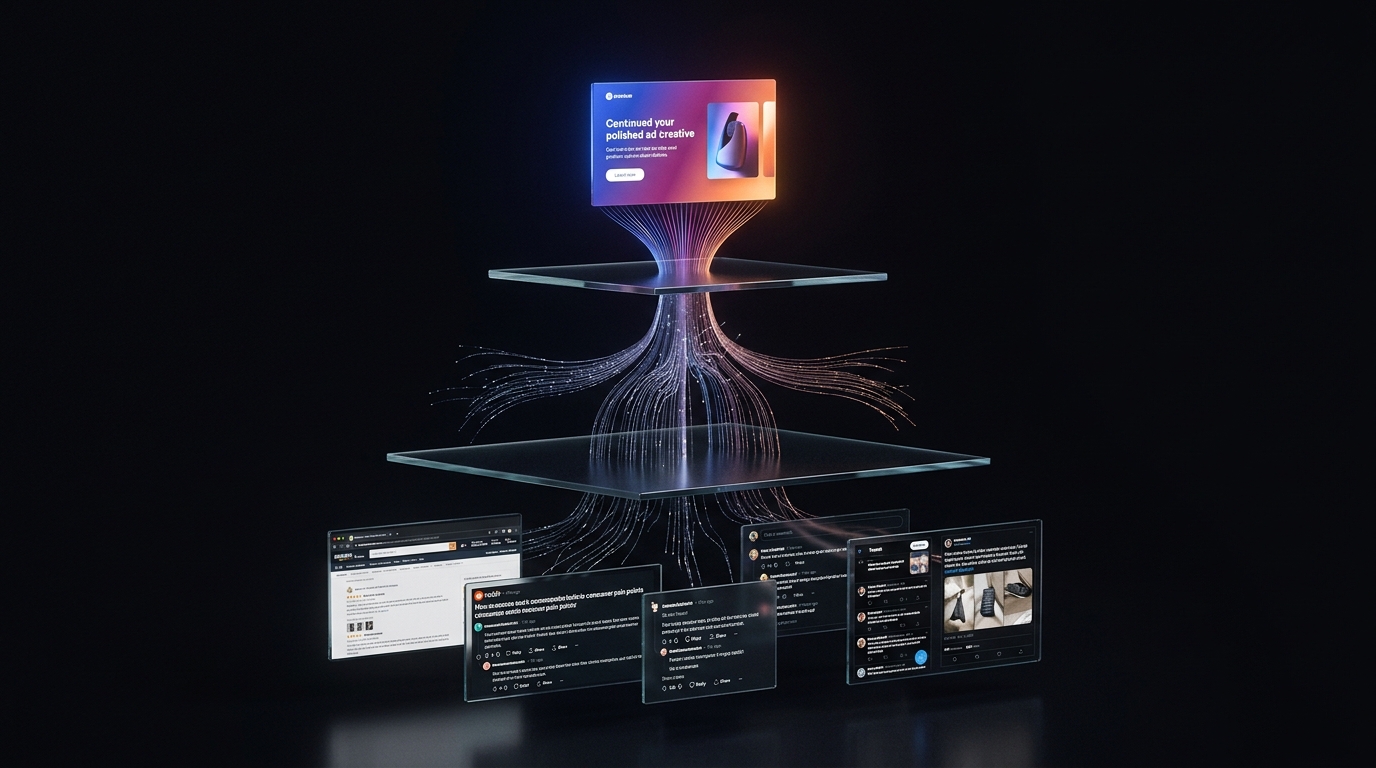
Step 1: Scrape Your Market
Before you open a design tool, you need to know what your market is saying. That means:
🛒
Amazon Reviews
500+ reviews across your product category and top competitors
💬
Reddit + Social
Relevant subreddits, TikTok comments, Instagram competitor analysis
🔍
Search + Trends
Google autocomplete, search trends, competitor ad libraries
Doing this manually: Open 15+ tabs. Copy-paste reviews into a spreadsheet. Read Reddit threads one by one. Manually tag recurring themes. Estimate 8-12 hours per brand, per campaign.
With AdForge: Enter a brand URL and product URLs. AdForge scrapes all sources automatically, runs AI sentiment analysis, and delivers a structured intelligence report in minutes.
Step 2: Build Grounded Personas
"Millennials who like fitness" is not a persona. It's a filter. A real persona needs to be specific enough that you could write a direct mail letter to them.
The manual process
Pull Census Bureau data from api.census.gov (you'll need an API key and knowledge of FIPS codes and ACS table IDs). Cross-reference with psychographic data from MRI-Simmons or Claritas ($15K+/year subscriptions). Manually build 3-5 persona profiles in a document. Budget 4-6 hours per persona if you know what you're doing.
With AdForge: Select a brand and product. AdForge generates 1-5 Census-validated personas in seconds, each grounded in real demographic data for the target market: income, education, household composition, age, location, psychographic patterns, and media habits.
Step 3: Test Concepts Before You Spend
This is the step most agencies skip entirely, because doing it properly is expensive and slow.
You need to write 3-5 concept briefs and test each one against your target audience. Traditionally, that means booking a focus group facility ($8K-$15K), recruiting participants (2-3 weeks), running the session, transcribing, and analyzing. By the time you have results, the campaign window has closed.
With AdForge: Write your concepts and run them through AI focus groups with your Census-validated personas. Each persona responds based on their demographic profile. Ask follow-up questions. Get results in minutes, not months.
Step 4: Generate Creative with Context
Now you've earned the right to open a design tool. But even here, the manual process is painful:
What a proper creative brief requires
| Target | Specific persona with demographics, psychographics, and pain points |
| Concept | A validated angle that tested well in focus groups |
| Language | Exact words and phrases from your audience research |
| Visual | Direction informed by competitive context and persona preferences |
| Platforms | Platform-specific formats with safe-zone awareness |
Most agencies write a brief that says "make it pop" because they don't have the research to write a real one.
With AdForge: Every creative you generate is automatically informed by your intelligence report, personas, and focus group results. The platform builds the brief from data you've already collected, then generates platform-ready ad creative across multiple formats.
Step 5: Build for Multiple Platforms
Meta Feed (1:1)
Product center, headline top, CTA bottom.
Instagram Stories (9:16)
Full bleed, text in safe zone, 3 seconds to hook.
TikTok (9:16)
Native feel, avoid looking like an ad.
LinkedIn (1.91:1)
Professional tone, data-forward, longer headline.
Doing this manually: Create each variant separately in Canva or Figma. Resize, reposition text, adjust safe zones per platform. Multiply by number of concepts. Easily a full day of production work.
With AdForge: Select your platforms during creative generation. AdForge produces platform-specific variants with correct aspect ratios and safe-zone awareness from the start.
Step 6: Generate Platform-Specific Audiences
The final step most tools ignore completely: translating your validated personas into platform targeting parameters.
Doing this manually: Open each ad platform. Manually research interest targeting options. Try to map your persona's demographics to available targeting parameters. Different UI for Meta, Google, LinkedIn, and TikTok. Hours of work per platform.
With AdForge: Click a button. AdForge translates each persona into platform-specific targeting specs for Meta, Google, LinkedIn, and TikTok automatically.
Why Agencies Can't Do This Without a Platform
Manual Pipeline
- 8-12 hours of research per brand
- 4-6 hours per persona (Census + psychographics)
- $8K-$15K per focus group
- 1-2 days of creative production
- Hours of per-platform targeting setup
- Total: 2-4 weeks, $10K-$50K
With AdForge
- Automated scraping + AI analysis
- Census-validated personas in seconds
- AI focus groups on demand
- Data-backed creative generation
- Multi-platform targeting in one click
- Total: under an hour
The math is simple: doing it right manually is too expensive for most agencies. Doing it wrong (skipping research) wastes money on underperforming creative. AdForge makes doing it right the default.
The agencies that build this muscle in 2026 will be the ones that win in 2027. Not because the technology is secret, but because starting with research is the hard part, and AdForge makes it easy.
Ready to try data-backed ad creative?
Join the AdForge waitlist. Refer 3 colleagues to skip the line.
Get Early Access